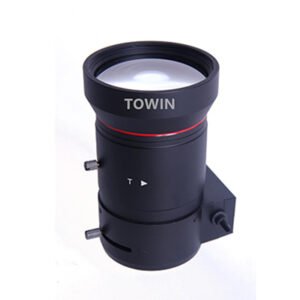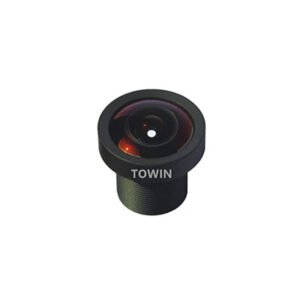

In the rapidly evolving field of industrial automation, machine vision lenses are the unsung heroes enabling robots, inspection systems, and smart devices to “see” with human-like accuracy. Central to their performance is a fundamental parameter: focal length.
What is the Focal Length of a Machine Vision Lens?
The focal length of a machine vision lens is the distance between the lens and the image sensor when the subject is in sharp focus. Measured in millimeters (mm), it determines the field of view (FOV), magnification, and working distance—critical factors for applications like quality inspection, robotic guidance, and 3D scanning.
A shorter focal length (e.g., 8mm) captures a wider FOV, ideal for scanning large objects, while a longer focal length (e.g., 50mm) narrows the FOV, enhancing detail for distant or small subjects. For instance, Towin’s TFV-12M series offers focal lengths ranging from 6mm to 100mm, catering to diverse industrial needs.
Key Parameters of Machine Vision Lenses
- 1. Aperture (F-Number): Controls light intake. A lower f-number (e.g., f/1.4) allows more light, improving low-light performance. Towin’s lenses, like the TFV-25M, feature adjustable apertures for versatility.
- 2. Resolution: Measured in line pairs per millimeter (LP/mm), it dictates image sharpness. Towin’s lenses achieve resolutions up to 5MP, ensuring crisp details for high-speed inspections.
- 3. Mount Type: C-mount (17.52mm flange distance) and F-mount (46.5mm) are common. Towin’s TFV-C series uses C-mount for compact integration with cameras like Basler and FLIR.
- 4. Distortion: Minimal distortion (<0.1%) is vital for accurate measurements. Towin’s lenses employ aspherical elements to eliminate barrel or pincushion distortion.
- 5. Spectral Range: Determines light compatibility (visible, IR, or UV). Towin’s TFV-IR series supports 850nm infrared, ideal for night-vision applications.
Why Towin’s Machine Vision Lenses Stand Out
Towin’s lenses are engineered for industrial rigor, combining precision with durability:
- High-Precision Optics: Multi-coated lenses reduce flare and ghosting, enhancing contrast.
- Compact Design: Lightweight yet robust housings withstand vibrations and temperature fluctuations.
- Customization: Focal lengths, apertures, and coatings can be tailored to specific needs.
- Global Compliance: Certified for CE, RoHS, and FCC standards, ensuring safety and reliability.
FAQs
How does focal length affect image quality?
Focal length influences FOV and magnification. A mismatched focal length can lead to blurred edges or insufficient detail. Towin’s lenses are optimized to balance these factors for crystal-clear imaging.
Can I use a longer focal length for close-up inspections?
No. Longer focal lengths reduce FOV, requiring greater working distances. For close-ups, opt for shorter focal lengths (e.g., 12mm) or macro lenses.
What is the best focal length for robotic arms?
It depends on the task. For picking small parts, a 16mm lens offers a good balance of FOV and detail. Towin’s TFV-R series includes robotic-specific lenses with anti-shake technology.
Are Towin’s lenses compatible with all cameras?
Mostly, yes. Towin supports C-mount, F-mount, and M12 interfaces, compatible with brands like Sony, Teledyne Dalsa, and Allied Vision. Check specifications for exact compatibility.
Conclusion
What is the focal length of a machine vision lens? It’s the cornerstone of visual accuracy, shaping how machines interpret the world. Towin’s lenses, with their meticulously engineered focal lengths and advanced features, empower industries to achieve unparalleled efficiency and reliability.